

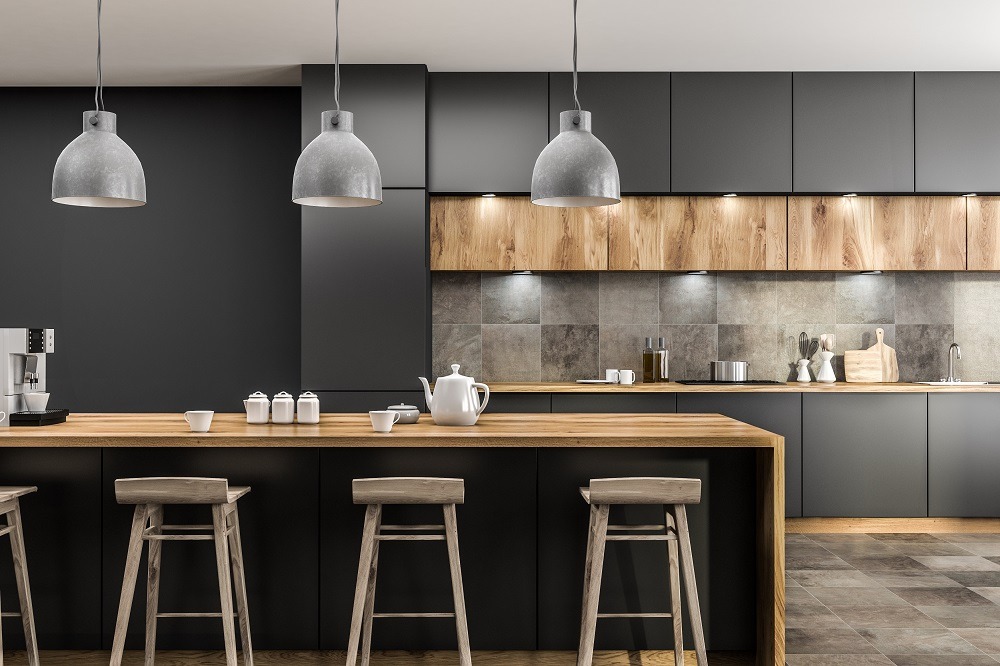
Homeowners dream of remodeling their kitchens and hyperfixate on a specific number, building expectations around it. That’s an understandable position, but keeping that number realistic requires understanding project scope. A $25,000 project and a $70,000 project look very different. They can have entirely different cabinetry, countertops, and backsplashes. Add layout changes and plumbing moves to the mix, and the project expands far beyond its original scope.
Prevent that from happening by understanding what each cost tier actually pays for.
Quick Answer
According to Angi, the average kitchen remodel costs $26,943, with most projects falling between $14,589 and $41,540. Minor cosmetic updates run $10,000 to $20,000. Major remodels with new cabinets, countertops, and appliances run $20,000 to $65,000. Full gut renovations with layout changes start at $65,000 and regularly exceed $130,000. Cabinets consistently claim 30 to 40 percent of total budget regardless of scope.
| Remodel tier | Typical cost range | What it usually includes |
| Minor remodel | $10,000 to $20,000 | Cosmetic updates such as countertops, hardware, backsplash, lighting, paint, appliance updates, and cabinet refacing or door replacement without layout changes |
| Major remodel | $20,000 to $65,000 | Full cabinet replacement, new countertops and appliances, new flooring, updated lighting, and minor layout adjustments that do not move plumbing or walls |
| Full gut remodel | $65,000 and up | Complete tear-out, layout changes, plumbing or electrical relocation, possible structural work, and higher-end finish selections |
What the Average Kitchen Remodel Cost Actually Covers
According to Angi, the national average for a mid-range kitchen remodel is $26,943. That estimate reflects a middle-of-the-road scope, with updated cabinets, countertops, appliances, flooring and lighting. No layout changes, plumbing, or structural work. Per square foot, that’s about $75 to $250. But this is just an average; moving walls, plumbing, or custom fixtures push costs into the next tier.
Minor Remodel: What $10,000 to $20,000 Gets You
A minor remodel at this budget level covers new countertops, hardware, backsplash, lighting, paint, and appliance updates. Existing cabinet boxes stay. The doors and drawer fronts can be replaced or refaced, but the structure remains.
This is also the scope with the strongest return on investment. The 2025 Cost vs. Value report from JLC puts minor kitchen remodel ROI at approximately 113 percent nationally, making it the only interior renovation that consistently adds more value than it costs. A well-executed cosmetic refresh in a home where the kitchen worked but was visually dated adds more than the project costs to resale value.
Major Remodel: The $20,000 to $65,000 Range
A major remodel in this range usually includes some full replacements mixed in with the surface updates. Instead of simple refacing, cabinets might get fully replaced. New countertops, appliances, flooring, and lighting are matched to the rest of the scope. Small layout adjustments fall into this range, as long as they don’t involve moving sinks or opening walls. Most full kitchen renovations fall into this category.
At this tier, cabinets usually eat 30% to 40% of the total budget. If the whole project is $35,000, the cabinetry alone runs $10,500 to $14,000. Permits add $460 to $2,770 regardless of scope. They’re a fixed cost in any project involving electrical or structural work. New flooring adds $1,000 to $5,000, depending on material and square footage.
The Components That Drive Average Kitchen Remodel Cost Up
Most kitchen remodel budgets run over for one of two reasons. Either the homeowner underestimated the cabinet tier they actually wanted, or the scope expanded once work began without a defined change order process. The line items that most consistently push a project above its original estimate are cabinets, countertops, and labor. Each operates on its own logic.
Cabinets: The Line Item That Dominates Every Budget
Cabinets take up 30% to 40% of kitchen remodel budgets, making them the most expensive part of many projects. Whether the budget is $20,000 or $50,000, cabinets still take the same share of that budget. The change lies in the fixture tiers. Standard cabinets with standard box sizes cost less than semi-custom cabinets with specific finishes, or than fully custom cabinets built to match the specific dimensions of the space.
The cabinet decision is the single choice that most commonly moves a project from one cost tier to the next. Choosing semi-custom cabinets after setting the budget causes the budget to balloon by thousands.
Countertops, Labor, and the Costs Homeowners Underestimate
Countertops are the second most common source of budget surprise. According to Angi’s galley kitchen remodel data, laminate countertops average $800 to $1,650 for a standard kitchen. Quartz runs $1,500 to $12,000, depending on slab selection and edge profile. Just like cabinets, selecting countertops after setting a budget can cause costs to skyrocket, depending on the selection.
Labor underscores the entire project. A general contractor overseeing the full scope charges 10 to 20 percent of the total project cost on top of individual trade rates. That covers scheduling, subcontractor coordination, permit management, and the accountability that comes with a licensed contractor. Contractor training programs that certify the tradespeople working on kitchen remodels establish the professional standards behind those rates. Certified plumbers, electricians, and carpenters produce fewer post-completion problems and inspections that pass the first time.
Appliance installation adds $125 to $300 per unit on top of the appliance purchase price. It’s easy to overlook when budgeting from sticker prices alone.
When Layout Changes Rewrite the Budget
The most important cost threshold in a kitchen remodel is the line between keeping or changing the existing layout. Every fixture that stays in place is a plumbing and electrical connection that does not need to move. Every fixture that moves requires new rough-in, new supply lines, and sometimes a permit that adds cost and time.
What Moving the Sink or Changing the Footprint Costs
All layout decisions, including where the sink goes, need to be finalized before any work begins. Once a specific cabinet configuration is ordered, moving the sink requires ordering new cabinets or opening the walls. Both add huge expenses to the budget.
Licensed plumbers who assess kitchen plumbing scope before remodel work begins provide the information needed to make that decision correctly. The consultation happens while the design is still on paper, so changing the sink’s location costs nothing. Discovering a plumbing conflict after ordering cabinetry is a different category of problem.
The same logic applies to wall removal. A wall that turns out to be load-bearing requires structural assessment, potentially a beam, and permits that extend the project timeline. Knowing that upfront shapes the entire project scope, budget, and timeline. Kitchen remodeling contractors who handle design, permits, and construction under one roof do this assessment before finalizing anything. Again, that’s the only stage where these changes are free.
Average Kitchen Remodel Cost and Your Home’s Value
The 2025 Cost vs. Value report from JLC puts minor kitchen remodel ROI at approximately 113 percent nationally and major kitchen remodel ROI at approximately 50 percent. The gap between them stems from the mixture of project cost and buyer perception. A $15,000 to $20,000 cosmetic refresh in a home with a working, but dated kitchen adds immediate, legible appeal. A $100,000 custom kitchen in a neighborhood where comparable homes sell for $350,000 outspends the market.
Scope and neighborhood both matter more than finish quality when calculating kitchen remodel ROI. Home improvement projects that return the most at resale consistently rank minor kitchen updates near the top.
Getting a Kitchen Remodel Quote That Reflects Real Scope
A useful kitchen remodel quote specifies scope by trade. What cabinet line and tier? What countertop material? What appliances are included? These, among others, are all important, relevant questions homeowners need the quotes they get from local contractors to answer. No quote should ever just say “kitchen remodel, $50,000” because it doesn’t convey any information.
Two quotes at similar prices can describe completely different projects when the specifications are not listed. The homeowner who receives an itemized quote and a non-itemized quote can’t make a valid comparison between them.
Written itemized kitchen remodel estimates that separate labor, materials, and timeline before work begins give homeowners a line-by-line reference point. Questions to ask a kitchen remodeling contractor before committing to a quote covers the full vetting process once estimates are in hand.
Frequently Asked Questions
What is the average cost of a kitchen remodel?
According to Angi, the average kitchen remodel costs $26,943, with most projects falling between $14,589 and $41,540. Minor cosmetic updates run $10,000 to $20,000. Major remodels with new cabinets and countertops run $20,000 to $65,000. Full gut renovations with layout changes start at $65,000.
What is the most expensive part of a kitchen remodel?
Cabinets. According to Angi, cabinetry consistently claims 30 to 40 percent of total kitchen remodel cost regardless of project scope. On a $35,000 mid-range project, the cabinet line alone runs $10,500 to $14,000.
Is a $30,000 kitchen remodel realistic?
Yes, for a major remodel that keeps the existing layout. At $30,000 a homeowner can realistically expect full cabinet replacement at a mid-range tier, new countertops, updated appliances, new flooring, and refreshed lighting without moving plumbing or knocking walls. Layout changes and structural work push the budget above this range.
Does a kitchen remodel increase home value?
Yes, with meaningful variation by scope. The 2025 Cost vs. Value report from JLC puts minor kitchen remodel ROI at approximately 113 percent nationally, the strongest return of any interior renovation. Major kitchen remodels average approximately 50 percent ROI nationally.
How long does a kitchen remodel take?
According to Angi’s galley kitchen remodel data, a kitchen remodel takes six to ten weeks on average for the construction phase. Planning and design need an extra four weeks before work begins. Projects involving layout changes, custom cabinetry, or special-order appliances typically run longer.
What the Estimate Can’t Tell You
The estimate tells you what the project costs if everything goes to plan. What it cannot tell you is what happens when demo opens a wall and finds knob-and-tube wiring, or when the countertop slab the homeowner selected at the showroom is no longer in stock six weeks later. These are routine issues on any project in a home over twenty years old.
The homeowners who stay closest to their original budget are almost always the ones who asked what the change order process looks like before signing anything. A contractor who cannot answer that question clearly before work starts will not answer it clearly after a surprise appears mid-project either.
Sources
How Much Does a Kitchen Remodel Cost? — Angi
How Much Does a Galley Kitchen Remodel Cost? — Angi
2025 Cost vs. Value Report — Zonda/JLC