

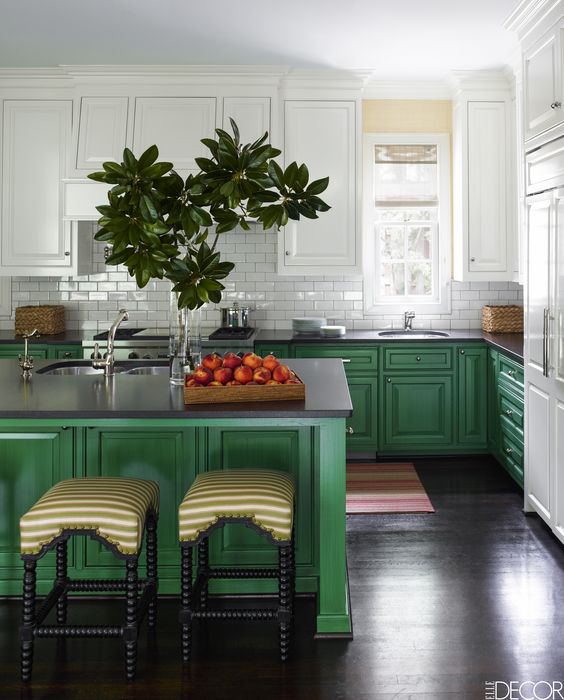
At the end of the day, the right shade of color for anything in your home is up to your preference. But choosing “green” kitchen cabinets tends to start with the rest of the established room, not fleeting trends. The trendiest shade (that’ll likely be less popular in a week) can look great in isolation, but melt into a muddy mess once the rest of your kitchen surrounds it.
2027 Is Pushing Green in Several Different Directions
Green keeps showing up in early 2027 color announcements, but the shades are not interchangeable. Sherwin-Williams chose Celery SW 6421, a soft, muted green with subtle yellow undertones. Behr went deeper with Grounded T27-01, a mossy olive anchored by earthy brown. Dulux chose Soulful Sage, a much lighter sage with a heritage feel.
All those colors fit the description of green, but putting them on the same cabinets would result in astronomically different vibes. We can infer this from established history. Sage and pistachio were traditional kitchen paint colors long before 2027. Benjamin Moore’s October Mist 1495, its 2022 Color of the Year, is another reference point. Its gently shaded sage sits between a warm olive and a brighter yellow-green.
Four Shades Worth Testing for Green Kitchen Cabinets
Trends are great for ideas, but when push comes to shove, everyone will move on to the next best thing shortly. That’s why they shouldn’t make up large percentages of your final choice. When evaluating colors and shades, always put the samples directly beside your counter instead of testing in a vacuum.
For a north-facing kitchen with white or cool gray-veined quartz, Celery SW 6421 is worth testing first. North light can make colors look cooler and duller, while Celery carries enough yellow to resist some of that gray cast.
For oak floors, butcher block, or aged-brass hardware, Behr Grounded T27-01 makes more sense as a starting point. Its moss, olive, and brown direction make it a great companion to warm wood. It is a deeper color, though, so it suits a kitchen with decent daylight better than a small room with one narrow window.
A small or dim kitchen needs less visual weight. Dulux Soulful Sage is a useful color reference because it stays on the lighter, softer end of sage instead of moving toward forest green. Since Dulux isn’t sold in most US stores, it works as a shade to color-match rather than a can to buy. It can still gray down in dim light, so leave the sample up a full day before deciding it is “light enough.”
For a kitchen dominated by stainless appliances, cool white tile, and gray stone, Benjamin Moore October Mist 1495 is another good sample to bring home. Its grayer, gently shaded sage is less likely to fight the cool metals. If the room already feels cold, place it beside Celery as well. Celery’s warmth may keep the finished kitchen from drifting too gray.
Again, there’s no universal “best green.” This is all subjective, but these shades make great starting points because each serves a distinct purpose.
Light Can Change the Color Before the Counters Do
North-facing rooms get cooler, steadier light, which mutes warm colors and grays down greens. It’s the same phenomena that mars paint colors for low-light rooms. Cabinetry adds a complication, though: vertical doors, shadowed rails, and recessed corners break the color up. Artificial light changes it again.
A pale yellow-green under cool, bluish LEDs can go sallow enough to make a new kitchen feel like a dingy hospital corridor. Warm-white bulbs around 2700K to 3000K are less likely to pull a yellow-green in that direction. Don’t forget the under-cabinet lights, either. They hit lower doors from a different angle than the ceiling fixtures, and two LED temperatures can make upper and lower cabinets look like slightly different colors.
A pale green that looks balanced in the morning can wash out in direct afternoon sun. Forest and hunter greens hold their depth in a bright kitchen but can feel heavy in a dim room. Dark green kitchen cabinets also show everyday dust and fingerprints more easily. Fingerprints show most on a pantry door or the cabinet beside the refrigerator where hands land all day.
Basic advice for choosing interior paint colors applies here: judge the color in the room where it will live. A family-room green ten feet away is not proof that the same color will work under different windows and different bulbs.
Let the Counters, Floors, and Hardware Vote Too
Fixed materials are usually your best bet for determining whether you need warmth or coolness in your kitchen because they’re the most integral. White quartz floors give a gray or silver-green something to connect to. Honey oak, butcher block, and warm stone push toward olive, celery, and warmer sage.
A plain white subway backsplash gives you more room to go dark. Busy patterned tile already carries several colors, so adding a complicated green can cause the cabinets and backsplash to clash. Hardware changes the reading too. Switching polished chrome for aged brass can make green kitchen cabinets look noticeably warmer.
That is one reason to sample Grounded with warm wood and brass, and October Mist around cool stainless and gray stone. Celery lands between the two, with a yellow undertone that suits oak and a light enough value for a small kitchen. Stainless appliances deserve to be part of the sample test. A kitchen with a stainless refrigerator, range, hood, and dishwasher contains a large amount of cool gray even without the cabinets.
Painting Green Kitchen Cabinets Works Only If the Boxes Are Sound
Cabinet painting is mostly preparation. A thorough cabinet refinishing process starts with taking off doors and hardware, cleaning away cooking grease, and preparing the existing finish so the new coating can bond.
Painters spray doors and drawer fronts for a smoother finish and coat the boxes in place, so much of the kitchen stays intact. Painting also reuses the existing boxes and doors. The quote therefore pays for prep and finishing rather than cabinet demolition, fabrication, delivery, and installation. That is the more useful distinction when comparing refinishing with the cost of a larger kitchen remodel.
But even the most beautiful green paint can’t save a terrible cabinet. Problems with the cabinets themselves should always be prioritized because they ‘re still sagging regardless of what color they are. If several boxes need structural work, the refacing-versus-replacement decision belongs ahead of paint samples.
Before You Commit to Green Kitchen Cabinets
Will green kitchen cabinets look dated in a few years?
Not necessarily. Shade has more influence on longevity than the word “green.” House style counts too. A soft sage can look settled in an older Colonial while a bright acidic green may feel deliberately contemporary.
If commitment is the concern, limit green kitchen cabinets to the island or lowers and leave the uppers neutral so future color changes become less daunting.
What sheen works best on painted cabinets?
Satin and semi-gloss are the usual choices because both stand up to wiping, splatter, and handling better than flat paint. Semi-gloss cleans easily, but its extra shine shows dents, brush marks, and weak prep. A good coating system counts as much as the sheen name, since cabinets need a finish that cures hard enough for doors, drawers, and repeated cleaning.
How soon can you use painted cabinets again?
Painters can often rehang doors within a few days, but rehanging is not the same as full cure. Cabinet enamel keeps hardening after it feels dry to the touch. Until then, skip hard scrubbing and watch anything that could stick to the fresh coat. Cure time depends on the coating, so it is worth getting that number from the painter before the job starts.
Test the Green on Something Bigger Than a Paint Chip
A tiny chip cannot show what a color will do across twelve feet of cabinet doors. Paint a large sample board or, even better, the back of a spare cabinet door. Put it beside the countertop in the morning, look again with the under-cabinet lights on, then check it at night under the ceiling fixtures.
Before-and-after cabinet refinishing examples are useful for judging finish quality and seeing how much a painted kitchen can change. They are not substitutes for a sample in your own room. Leave that sample in place for several days. The green that survives north light, dinner-hour LEDs, stainless appliances, and the countertop is the one worth putting on every door.
Sources
Domino, Sherwin-Williams’s 2027 Color of the Year Is Deeply Refreshing
Sherwin-Williams, Color of the Year 2027: Celery SW 6421